In health and performance, we often talk about being open-minded. We praise curiosity. We value expertise. But rarely do we examine how those two qualities exist in tension with one another.
On one end of the spectrum lies pure openness—a state defined by direct experience, exploration, and curiosity. On the other end lies pure specialization—a state defined by deep knowledge, refined skill, and narrow focus.
Both are essential. Both are powerful. But both can become problematic when taken to their extremes.
Understanding the openness continuum can help us better navigate health, training, and clinical decision-making.
TWO ENDS OF THE CONTINUUM
Imagine a spectrum.
On the far left is pure openness.
On the far right is pure specialization.
Neither side is inherently good or bad. They simply represent different ways of interacting with health and the human body.
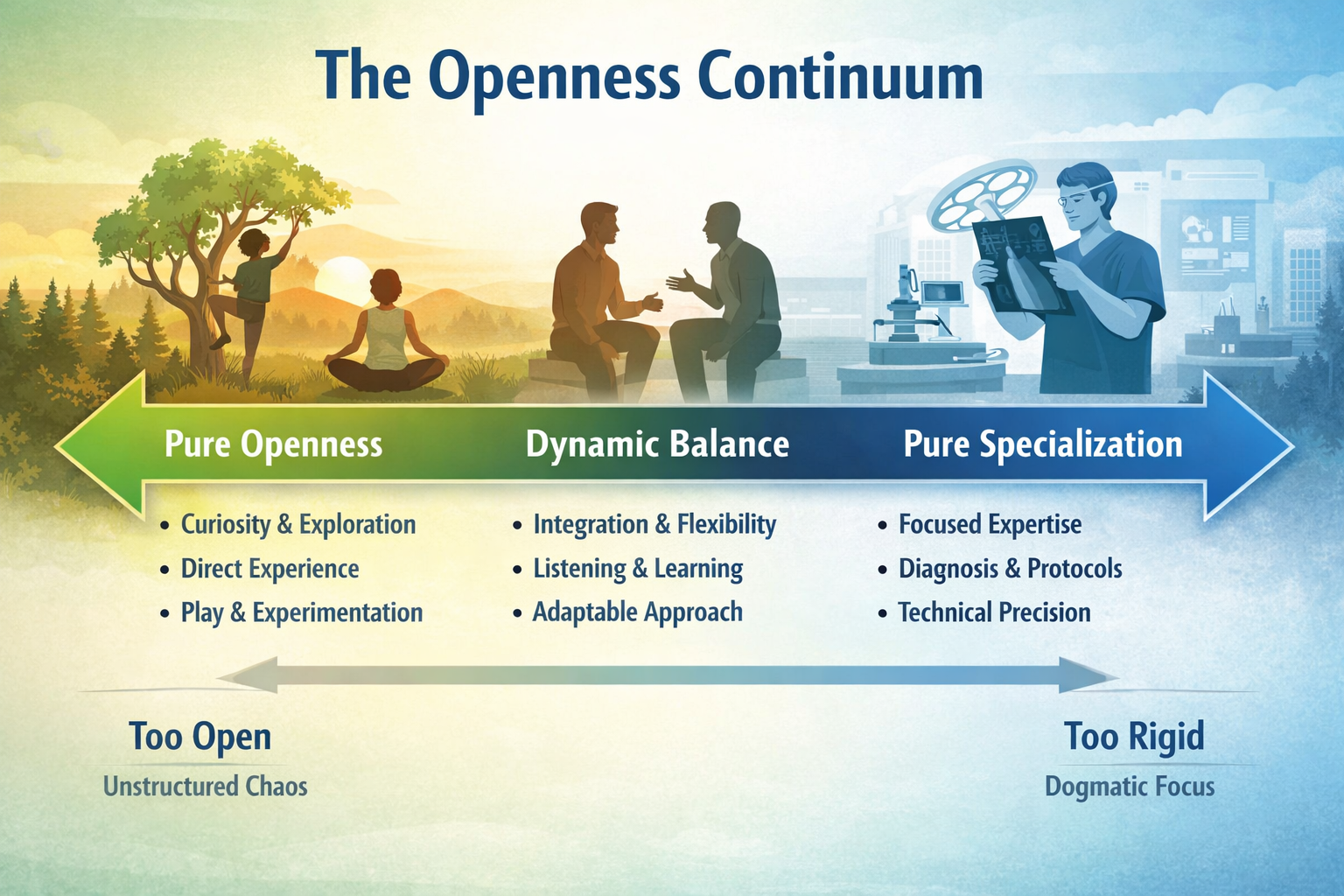
Pure Openness: The World of Direct Experience
At the open end of the continuum, an individual interacts with health primarily through direct experience rather than structured expertise.
This might look like:
A child climbing trees and running through fields
Someone exploring new physical activities with no agenda
A person experimenting with movement simply because it feels interesting
Listening to internal sensations without immediately labeling them
This side of the spectrum is defined by curiosity rather than certainty.
There is very little filtering of experience through professional frameworks. The body learns through interaction with the environment.
From a developmental standpoint, this type of openness is incredibly valuable.
Children develop coordination not through perfectly structured programs, but through play. They explore balance, strength, impact, and speed through thousands of varied interactions.
In many ways, health begins here—with the freedom to move, explore, and learn through direct feedback from the body.
But pure openness has limitations.
Without some degree of structure, people may struggle to solve complex problems or understand injury, disease, and performance plateaus.
This is where specialization becomes valuable.
Pure Specialization: The Narrow Lens of Expertise
At the other end of the continuum lies pure specialization.
This is the world of the expert.
The orthopedic surgeon who performs one procedure thousands of times per year.
The physical therapist who studies a specific biomechanical model for decades.
The strength coach who refines a single training methodology through years of application.
Specialization allows us to do extraordinary things.
Modern healthcare exists because individuals dedicate enormous time and effort to deep, focused knowledge. Specialization allows complex surgeries, targeted rehabilitation, and sophisticated understanding of physiology.
But specialization also narrows perspective.
When we spend years viewing the world through a specific lens, that lens becomes our default interpretation of reality.
A surgeon may see structural problems everywhere.
A strength coach may see everything as a loading issue.
A physical therapist may interpret symptoms primarily through biomechanics.
These interpretations are not necessarily wrong.
They are simply partial.
Extreme specialization can drift toward what might be called functional narrow-mindedness. The deeper we go into a single model, the easier it becomes to overlook factors outside that model—and the easier it becomes to see people primarily through categories rather than as complex individuals.
The irony is that the very expertise that allows us to help people can also limit what we notice.
THE DANGER OF THE EXTREMES
Problems arise when either party becomes stuck at an extreme.
When Openness Lacks Structure
On the purely open side, people may endlessly experiment without guidance.
They may jump from one exercise trend to another or chase the newest wellness strategy without understanding foundational principles.
Without structure, experience becomes random rather than progressive.
Curiosity alone is not enough. At some point, curiosity must organize itself into understanding.
When Specialization Becomes Rigidity
On the specialized side, professionals can become overly committed to their frameworks.
Every problem begins to resemble the same solution.
Symptoms are forced into familiar patterns.
New information is filtered through existing beliefs rather than examined openly.
This is where healthcare can unintentionally drift toward dogma.
When specialization becomes rigid, people can slowly stop being seen as individuals and instead begin to resemble statistics, diagnosis codes, or case categories. The person disappears behind the classification.
When curiosity disappears, learning stops.
THE CURRENT STATE OF HEALTHCARE
It may seem intuitive that patients live closer to the open end of the continuum while healthcare professionals live closer to specialization.
In reality, the dynamic is more complicated.
Many patients enter healthcare seeking certainty. They want to know exactly what is wrong, what structure is involved, what diagnosis explains their symptoms, and what will fix it. They often look to specialists to translate their experience into something definitive.
Healthcare education reinforces this expectation. Clinicians spend years developing expertise within increasingly narrow domains, and specialization becomes a marker of authority.
Healthcare systems reinforce this even further. Insurance models, research funding, and institutional structures all favor clear diagnostic categories. Certainty makes it easier to allocate resources, standardize treatment, and determine reimbursement.
Over time, this creates a strong gravitational pull toward the specialized end of the continuum.
Patients often believe this is exactly what they want.
But they should be careful what they wish for.
Because while specialization provides powerful knowledge, it can also narrow the lens through which problems are interpreted.
Ironically, the person with the most direct information about the problem is the patient. They are the one experiencing the sensations, limitations, and context in which symptoms arise.
Their experience is raw data.
For that reason, patients should be encouraged to remain curious about what they are feeling, rather than immediately outsourcing interpretation to a diagnostic label.
At the same time, movement professionals and healthcare providers must resist the temptation to filter everything through their specialization too quickly.
The first responsibility is not interpretation.
The first responsibility is listening.
Listening to the experience before fitting it into a framework.
In a healthcare system already tilted heavily toward specialization, a little more openness can be incredibly valuable.
THE MOST EFFECTIVE PLACE TO BE
The most productive place on the openness continuum is not at either extreme.
It is somewhere in the dynamic middle.
This is where expertise and curiosity coexist.
A clinician working in this space maintains deep knowledge but continues to ask questions. Frameworks guide thinking without trapping it.
Patients also benefit from moving slightly toward structure—adopting evidence-based health behaviors while remaining attentive to how their individual body responds.
This balance allows experience and expertise to inform one another.
HEALTH AS AN ONGOING COLLABORATION
Health and well-being are not static states.
They require constant calibration between openness and specialization.
When learning something new, we often begin with openness. We explore and experiment.
Over time, structure develops. Technique refines. Knowledge deepens.
But even within expertise, periods of returning to openness are essential.
Athletes benefit from stepping outside their primary sport.
Clinicians grow by exploring ideas beyond their primary frameworks.
Even the most experienced professionals occasionally need to return to beginner’s mind.
Without that return, specialization slowly becomes stagnation.
A FINAL THOUGHT
Pure openness can drift toward chaos.
Pure specialization can drift toward rigidity.
But somewhere between those two lies a powerful place—where knowledge remains deep, curiosity remains alive, and experience continues to inform understanding.
In healthcare, that middle space is where the best conversations happen.
It is where clinicians continue learning.
It is where patients remain individuals rather than categories.
And it is where real progress tends to occur.