Many of us spend our lives pulled between two seemingly opposite forces: acceptance and action. When life becomes difficult, we often assume we must choose between them. Either we accept what is happening and risk becoming passive, or we take action and risk spending our lives fighting reality.
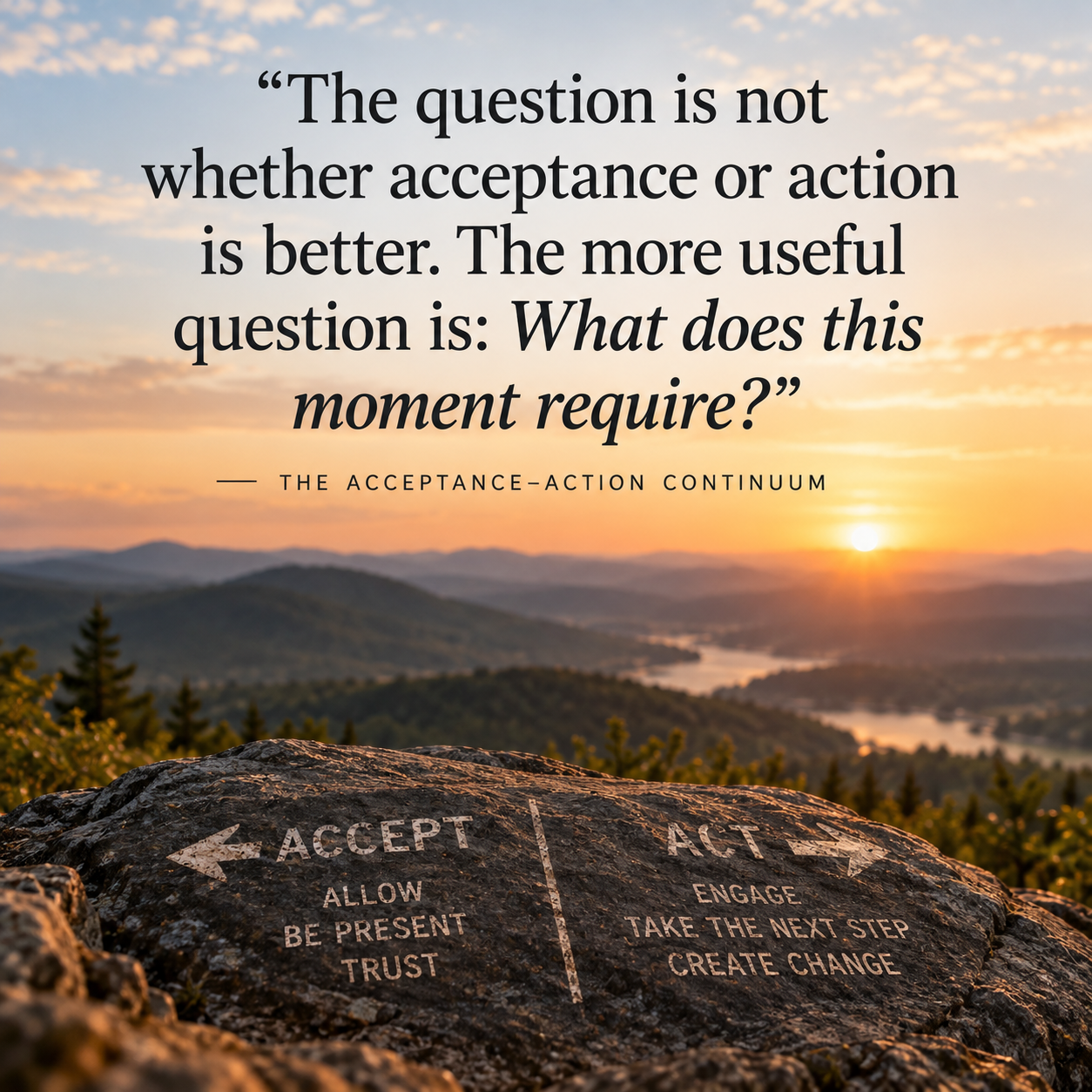
But acceptance and action are not opposites. They are two ends of the same continuum, and much of our ability to navigate uncertainty, discomfort, growth, and change comes from learning how to move between them. The question is not whether acceptance or action is better. The more useful question is: What does this moment require?
The Acceptance End
Acceptance begins with acknowledging reality as it exists—not as we wish it existed, not as it used to exist, and not as we hope it will eventually become. This sounds simple, but it may be one of the most difficult things we do.
We resist aging, uncertainty, change, uncomfortable emotions, loss, and outcomes we cannot control. Yet reality continues moving regardless of our opinion of it. People change. Bodies change. Relationships change. Circumstances change. Time moves forward. Acceptance recognizes that some things are already happening whether we approve of them or not.
Acceptance is the willingness to stop arguing with reality. It is not necessarily agreement or approval, and it does not require us to like what is happening. It is simply the ability to see what is already here clearly enough to stop spending unnecessary energy pretending it should not be.
The acceptance side of the continuum carries a distinctly parasympathetic quality. It is rest and digest. It is allowing rather than forcing, receiving rather than pursuing. It is a willingness to fall back into the support that is already present and trust that we do not need to control every variable. There is a certain amount of faith involved—not necessarily religious faith, but faith that this moment can be experienced without immediately trying to alter it. Faith that we can tolerate uncertainty, discomfort, sadness, frustration, and change without immediately needing to escape them.
This is where mindfulness becomes essential. Mindfulness allows us to notice sensations, emotions, thoughts, and impulses without immediately reacting to them. Sadness can be present. Fear can be present. Anger can be present. Joy can be present. We do not have to immediately grab onto the pleasant experiences or push away the unpleasant ones.
True acceptance approaches experience with equanimity. It attempts to appreciate the direct experience of the present moment without constantly manipulating it. We observe what is happening. We work with it. We move with it. Sometimes we simply allow it to be.
The goal of acceptance is not necessarily to feel better. It is to become better at feeling what is already here.
The Action End
If acceptance is about allowing reality to be what it is, action is about responding skillfully to that reality. Action is not denial of the present moment. It is participation in it.
The most useful question on the action side of the continuum may be remarkably simple: What is the next right step?
Notice what that question does not ask. It does not ask what will guarantee success, what life will look like five years from now, whether everything will work out, or what the perfect plan might be. Those questions pull us into a future that does not yet exist. The next right step keeps us here.
Action, therefore, requires mindfulness just as much as acceptance does. But it uses mindfulness differently. Acceptance uses awareness to experience the present without unnecessarily changing it. Action uses awareness to determine what can be skillfully done within it.
There is a sympathetic quality to action. There is energy, direction, effort, and movement. We step forward. We build, practice, train, solve problems, make decisions, and have difficult conversations. But healthy action is not frantic. It is not endless productivity or obsessive control. It is simply an appropriate response to what is actually happening.
This makes action fundamentally process-oriented rather than outcome-oriented. Goals can provide direction, but goals exist in the future. Action exists now. A healthier body is built through today's training, today's meal, and tonight's sleep. A relationship changes through the conversation you are willing to have today. A skill improves through the practice you can perform right now.
The future may influence our direction, but it cannot contain our action.
When Acceptance Becomes Passivity
Every useful quality has a point at which it can become distorted. Acceptance is no exception. Taken too far, acceptance can become resignation, passivity, or helplessness. Instead of accepting reality so that we can relate to it more clearly, we begin using acceptance as a reason not to participate.
"It is what it is" can represent tremendous wisdom. It can also become an excuse.
When we continually fall back without ever stepping forward, our world can gradually become smaller. We stop experimenting. We stop challenging ourselves. We stop gathering evidence that our behavior can influence our circumstances. At the extreme end of this direction lies hopelessness: the belief that nothing we do matters enough to warrant doing anything at all.
When acceptance loses its relationship with agency, it can begin to resemble resignation. Human beings need some experience of influence over their lives. Action provides evidence that our choices can matter.
When Action Becomes Control
Action has an opposite distortion. Taken too far, action becomes an endless attempt to control uncertainty. We begin to believe that safety exists somewhere in the future, provided we can just accomplish enough to finally reach it.
If I can solve this problem, then I can relax. If I can accomplish this goal, then I will feel secure. If I can just get through this week, then everything will settle down.
But life does not eventually become controllable. There is always another variable, another uncertainty, another problem, another change we did not anticipate. When action loses its relationship with acceptance, we can spend our entire lives attempting to control something that was never fully controllable.
The nervous system remains mobilized. Stillness feels threatening. Rest feels unproductive. The future becomes more important than the present. At its extreme, this direction can resemble the physiology and psychology of anxiety and panic: tremendous mobilization in response to uncertainty, with an increasingly urgent need to make something happen.
Action itself is not the problem. Action without acceptance is.
Where Suffering May Be Greatest
There is another place on the continuum that deserves attention because it may be where many of us spend the most time: somewhere in the middle, wanting something to change while neither accepting what is happening nor taking meaningful action to change it.
We resist reality, but we do not influence it. We complain, worry, ruminate, replay conversations, imagine different futures, and wait for circumstances to improve. Tremendous mental energy is being spent, but very little of it is being converted into purposeful behavior.
This is an especially frustrating place because there is neither the peace of acceptance nor the agency of action. We want reality to be different, but our relationship with reality remains largely unchanged.
Hope frequently lives here. Hope is enormously valuable. It can sustain us through periods when circumstances are genuinely beyond our control. But hope and action are not interchangeable. We can hope something changes while continuing to behave exactly as we always have.
Hope can point toward a better future. It cannot take the next step for us.
Mindfulness Creates the Choice
The acceptance–action continuum becomes useful only when awareness is present. Without awareness, we are simply reactive. We are dragged around by habits, fear, emotions, impulses, expectations, and whatever thought happens to be loudest at the moment.
Mindfulness creates enough space to ask a better question: Is this a moment for acceptance, or is this a moment for action?
Sometimes the answer is acceptance. The situation cannot currently be changed. The emotion needs to be felt. The loss needs to be grieved. The uncertainty needs to be tolerated. The body needs to recover. There may be nothing useful to do except experience what is happening without adding another layer of resistance.
Sometimes the answer is action. A difficult conversation needs to happen. A boundary needs to be established. A workout needs to begin. A decision needs to be made. A skill needs to be practiced. There is something within our influence, and continuing to think about it is no longer serving us.
And sometimes the answer is both.
We can accept that we are afraid while still taking the next step. We can accept that our body has changed while training the body we have today. We can accept uncertainty while making the best decision available with the information we currently possess. We can accept that something painful happened without allowing that event to dictate everything that happens next.
This may be where the continuum becomes most valuable. Acceptance and action do not need to take turns. They can coexist.
Moving With Life
A healthy life is not lived permanently at either end of this continuum. It requires movement between them: accepting what cannot be changed while acting on what can, allowing emotions to exist while taking responsibility for behavior, trusting the present moment while participating in the direction of the future.
There will be moments when the most skillful thing we can do is fall back, soften, observe, and allow. There will be other moments when we need to stand up, move forward, and do something. Wisdom is not found in becoming an "acceptance person" or an "action person." Wisdom is developing enough awareness to recognize what this particular moment is asking from us.
Acceptance allows us to stop fighting the reality that already exists. Action allows us to participate in what happens next.
Perhaps that is the balance we are actually looking for: enough acceptance that we are not constantly at war with life, and enough action that we do not simply wait for life to change around us.
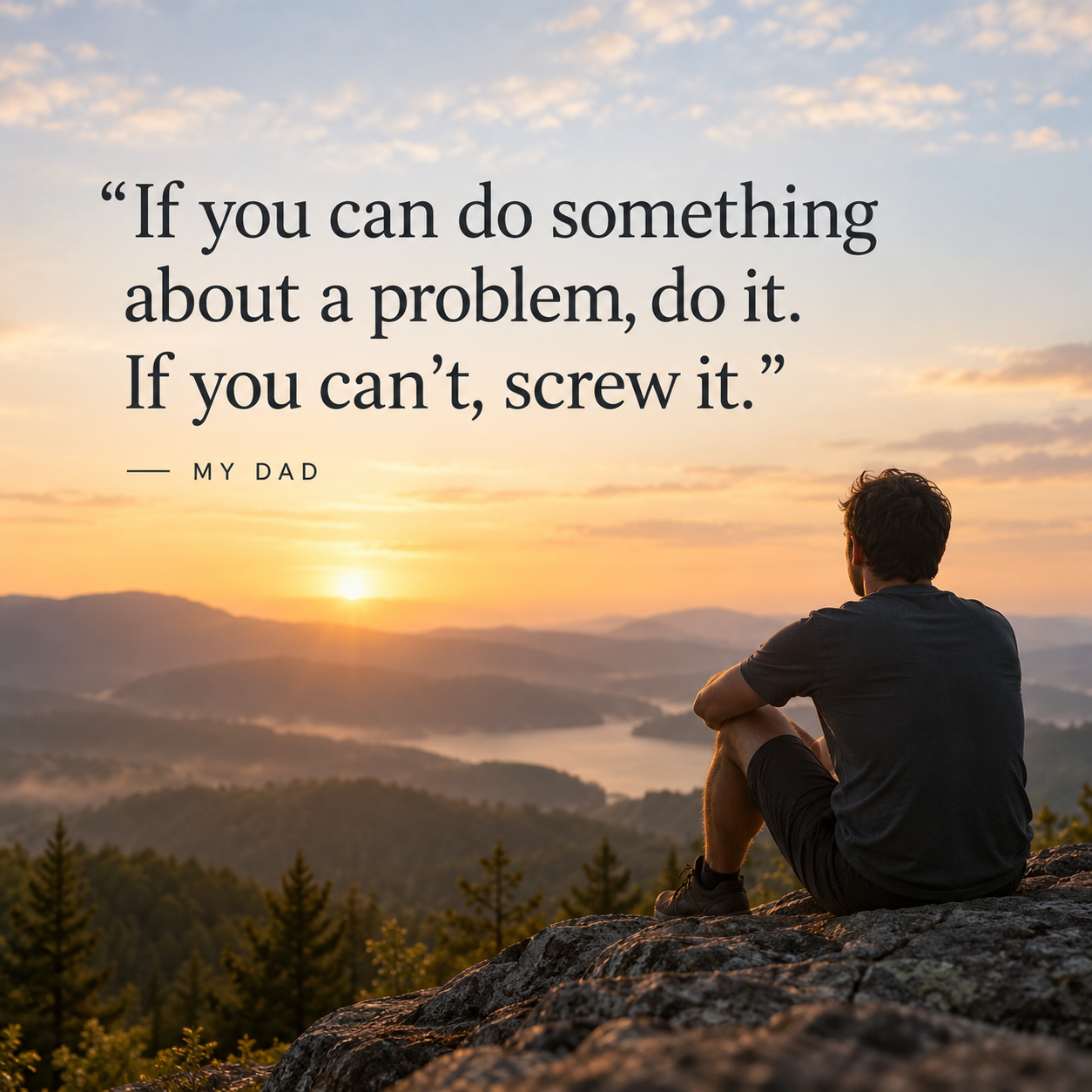
My dad has a much less philosophical way of explaining all of this:
“If you can do something about a problem, do it.
If you can't, screw it.”
As blunt as that sounds, there is a more than a little bit of wisdom packed into it. If something is within our influence, continuing to worry about it without acting accomplishes very little.
Do something!
If it truly falls outside our influence, repeatedly demanding that reality be different accomplishes very little either.
At some point, we have to let it be.
The difficult part, of course, is developing the awareness to know the difference.