At some point around middle age, the way we think about exercise tends to change. When we were younger, movement was often about discovering what we could do. How fast could we run? How high could we jump? How much could we lift? Could we climb that wall, make that shot, or keep up with everyone else?
Somewhere along the way, exercise becomes less about exploration and more about maintenance. We exercise because we don't want to gain weight. We stretch because we don't want our backs to hurt. We strength train because we've been told we need to preserve muscle as we age. We walk because it's good for our hearts.
These are all worthwhile reasons to move. But when exercise becomes entirely about preventing decline, something important can disappear from it. We stop asking what our bodies might still be capable of and start focusing primarily on what we're afraid of.
Remember When You Used to Move Fast?
Watch children play and you'll see power everywhere. They run when walking would work perfectly well. They jump off things they could easily step down from. They throw balls as hard as they can and race each other to destinations that aren't going anywhere.
Nobody has to explain the health benefits to them. Moving fast and expressing force simply feels good.
As adults, we gradually remove many of those experiences from our lives. By 40, plenty of people haven't sprinted in years. They can't remember the last time they jumped as high as they could or threw something with everything they had. Even our exercise tends to become more controlled and predictable.
Some of this is reasonable. We have different bodies, responsibilities, injury histories, and risk tolerances than we did at 18. But respecting those realities doesn't require abandoning powerful movement altogether.
In fact, if we never practice moving quickly, moving quickly eventually becomes something our bodies are no longer prepared to do.
Strength That Arrives on Time
Most people understand why strength matters as we get older. Strength helps us pick up our children, move furniture, get off the floor, and remain physically independent.
Power is closely related to strength, but it adds an important ingredient: time. It is our ability to produce force quickly.
Real life often requires exactly that. You stumble and have to catch yourself. Your dog suddenly pulls on the leash. You need to hustle across the street before the light changes. You misjudge a step coming off a curb. Something falls and you instinctively reach to catch it.
In those moments, you don't get several seconds to gradually develop force. Your body has to respond to what just happened.
This is why power training shouldn't be viewed exclusively as something athletes do to improve their vertical jump or sprint speed. It is also preparation for those moments when life suddenly asks us to act.
Rediscovering Something You Thought You Lost
One of the most interesting things about introducing power training to adults is seeing what happens when someone attempts a movement they haven't done in years.
Take jumping. Ask someone who hasn't jumped in a decade to jump onto a box and there is often a noticeable hesitation. They look at the box, reposition their feet, think about their knees, and wonder whether this is something a person their age should still be doing.
So we lower the box. Maybe we remove the box completely and simply practice leaving the ground and landing again.
They jump.
Nothing terrible happens.
Then they do it again.
The second attempt often looks different. There is less thinking and more doing. The movement gets faster. The landing becomes more confident. After a few repetitions, you sometimes see a smile.
That smile is interesting because it has very little to do with exercise technique. They have rediscovered something.
They remembered that they can jump.
That experience is one of the things I find most compelling about training. Progress isn't always about adding ten pounds to a lift or shaving thirty seconds off a mile. Sometimes progress is recovering access to something you had quietly stopped believing belonged to you.
We Are Drawn to Power
There is probably a reason these experiences feel so good. Human beings seem naturally drawn to displays of power.
Think about the moments in sports that make people jump out of their seats. The home run disappearing over the fence. The knockout punch. The slam dunk over a defender. The running back exploding through a tackle. The tennis serve that flies past an opponent.
The same pattern appears in entertainment. Superheroes launch themselves through the air. Cars accelerate. Doors get kicked open. Characters leap across gaps, throw things, smash things, and somehow walk away from explosions they probably shouldn't have survived.
Obviously, everyday life doesn't need to resemble an action movie. But our fascination with these moments tells us something about the experience of power.
Power is exciting because it represents potential becoming action.
A 400-foot home run is captivating because there is something almost startling about watching a human being create that much movement from a single swing. The moment contains strength, speed, timing, coordination, and commitment all at once.
Most adults eventually experience that feeling primarily as spectators. We watch someone else dunk the basketball. We watch someone else hit the home run. We watch someone else sprint, jump, throw, or fight.
Power training gives us a small opportunity to experience that quality again from inside our own bodies.
We're not trying to hit major-league home runs or knock anyone out. But swinging a heavy kettlebell, throwing a medicine ball, jumping onto a box, or accelerating into a short sprint allows us to participate in something we otherwise mostly watch.
There is a significant difference between witnessing power and experiencing yourself as powerful.
Power Demands Presence
Power training has another quality that becomes increasingly valuable in a distracted world: it demands attention.
It's difficult to think about tomorrow's meeting while you're preparing to jump. For those few seconds, you have to be where you are. You feel your feet, organize your body, judge the distance, and commit to the movement.
Then it's over.
In that sense, explosive exercise can become a form of mindfulness. We often associate mindfulness with becoming still, slowing down, and observing our thoughts. But presence can also emerge from complete engagement with an action.
Sometimes the mind becomes quiet because the body is doing something that requires all of it.
Power can create that experience. There is very little room for distraction in the instant between deciding to move and actually moving.
The Difference Between Caution and Capability
One of the unfortunate narratives around aging is that our physical lives should become progressively smaller.
Don't run anymore. Certainly don’t jump. Don't move too quickly. Be careful!
There is wisdom in understanding our limitations, and there are certainly movements and intensities that may not be appropriate for everyone. But there is a difference between respecting our current capacity and continually shrinking it.
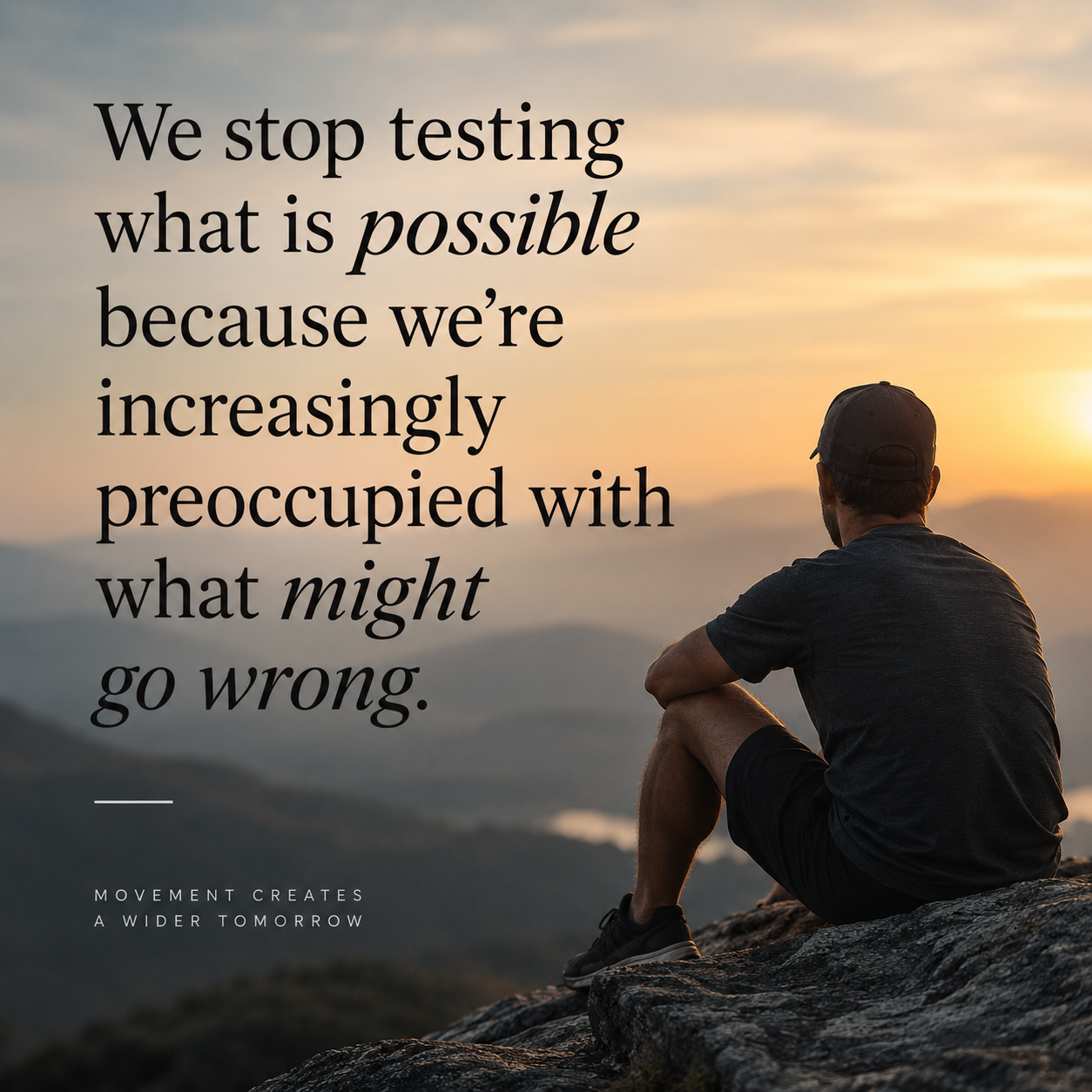
If exercise after 40 becomes entirely about avoiding injury and slowing decline, we can accidentally develop a relationship with our bodies built primarily around caution. We stop testing what is possible because we're increasingly preoccupied with what might go wrong.
That doesn't mean someone who hasn't sprinted in fifteen years should walk onto a track tomorrow and run a maximal 100 meters. It doesn't mean the person who hasn't jumped since high school should start with a three-foot box.
Power can be scaled just like strength.
We can jump lower before jumping higher. Throw lighter before throwing heavier. Accelerate before sprinting. Swing a lighter kettlebell before swinging a heavier one. For some, power training might simply mean standing from a chair quickly rather than slowly.
The movement matters less than the intention behind it. We are practicing the ability to produce force with purpose and eventually with speed.
Looking Powerful and Being Powerful
There is an important distinction between looking powerful and experiencing yourself as powerful.
Looking powerful is largely about how other people perceive us. Being powerful is something we discover through action.
It's picking something up that once intimidated you. It's jumping onto something you weren't sure you could reach. It's catching yourself when you stumble. It's learning a physical skill at an age when you assumed that possibility was mostly behind you.
Those moments become evidence. They remind us that aging doesn't have to be experienced solely as the gradual preservation of what remains. There can still be development, exploration, and surprise.
Perhaps this is one of the deeper purposes of training as we get older. We aren't simply trying to preserve muscle mass, maintain bone density, or reduce our risk of disease. Those things matter tremendously, but they don't fully capture why movement can be meaningful.
Training allows us to maintain a relationship with possibility.
At 40, 50, 60 and beyond, we can still chase things. We can still learn things. We can still become stronger and faster. We can still encounter physical experiences that require our complete attention and reveal capacities we didn't know we had.
And every once in a while, training gives us one of those wonderful moments where we stop, smile, and think:
Damn. I didn't know I could still do that.
Maybe that's one of the best reasons to train power in the first place.