When fear hits you in the gut, it’s impossible to miss.
Your heart starts racing, your chest tightens, and every instinct tells you to either run for your life or stand your ground. When there’s a clear threat right in front of you, you know exactly what’s going on.
But the fears that really hold us back usually aren’t that obvious.
They’re the ones lurking in the background.
They show up as that split-second hesitation before you try something new.
They’re the reason you keep putting things off.
Fear often hides behind other names: being judgmental, needing to be in control, staying in your comfort zone, or that exhausting need for everything to be perfect and certain before you start.
It’s great at sounding like common sense.
We tell ourselves we’re just being careful, the timing isn’t right, or we just need to do a little more research first.
Sometimes those excuses are valid.
But if we’re being honest, more often than not, it’s just fear running the show from behind the scenes.

Fear Rarely Travels Alone
Fear is a normal part of being human, and it actually has a job to do.
Without that internal alarm, we’d probably ignore real danger and put ourselves in serious trouble. The goal isn’t to get rid of fear entirely.
The trouble starts when these instincts quietly run the show without us even realizing it.
Once we label that nervous feeling for what it is, we can actually look at the facts and decide what to do next.
But when fear wears a good disguise, it starts making our choices for us.
Think about how avoidance works.
Backing away gives you an instant sense of relief. When things get uncomfortable and we step back, the tension goes away, and our brains learn a simple lesson:
That worked.
So, we do it again.
Over time, what started as a logical reaction to stress can end up making our world a lot smaller.
We stop trying things—not because we can’t do them, but because the "what ifs" just feel too heavy to carry.
This shift is especially easy to miss as we get older.
When Caution Becomes Identity
At some point, many adults begin receiving a steady stream of messages about what they should no longer do.
Be careful with your back.
Watch your knees.
Don't lift too heavy.
Don't run too much.
Don't fall.
Don't overdo it.
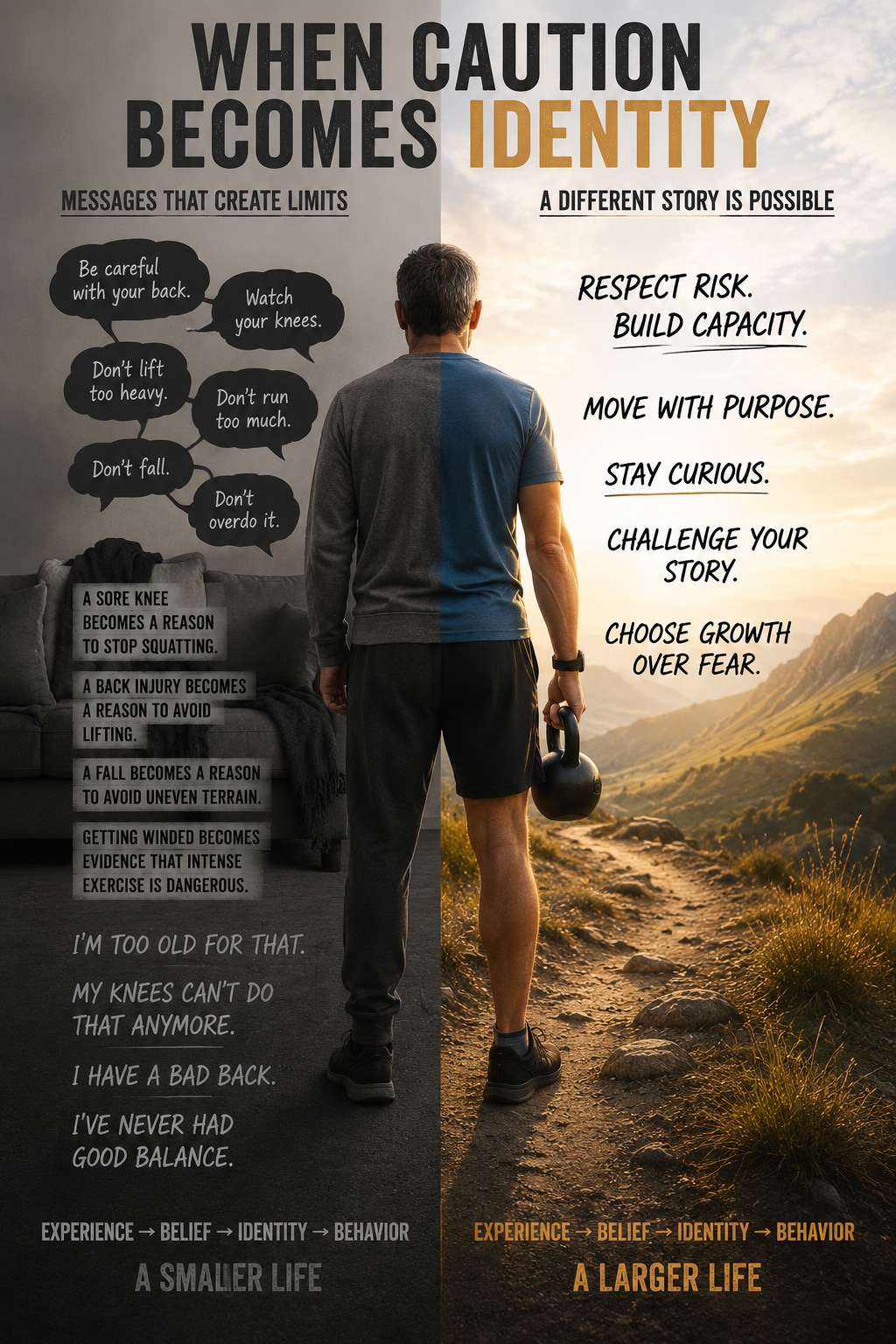
Some of this advice is reasonable. Bodies change. Injuries happen. Recovery changes. Our responsibilities increase, and the consequences of reckless decisions can become greater.
But there is a subtle difference between respecting risk and organizing your life around fear.
A sore knee becomes a reason to stop squatting.
A back injury becomes a reason to avoid lifting.
A fall becomes a reason to avoid uneven terrain.
Getting winded becomes evidence that intense exercise is dangerous.
Eventually, we may begin describing ourselves differently.
"I'm too old for that."
"My knees can't do that anymore."
"I have a bad back."
"I've never had good balance."
What began as an experience becomes a belief.
The belief becomes an identity.
And identity begins determining behavior.
Control Is Often Adjacent to Fear
We often try to control everything because uncertainty is stressful. We figure if we can just plan for every scenario and keep life predictable, we'll finally feel safe enough to move forward.
But here’s the reality: life, and our bodies, don’t come with guarantees. You can't promise you’ll never feel pain, get an injury, have a rough workout, or take a tumble.
Actually, trying to stay 100% safe often backfires. If you avoid uneven ground because you’re afraid of falling, your balance just gets worse. If you stop lifting anything heavy to protect your back, you actually get weaker, which makes you more prone to injury. If you skip tough workouts because you’re scared of getting tired, your body never builds the stamina you need.
We get so good at avoiding the things that make us uncomfortable that we end up avoiding the very challenges that would actually make us stronger.
Judgment Is Often Nearby Too
Fear often masquerades as judgment. When something makes us uncomfortable, our default is to dismiss it.
"That’s just dumb."
"Who would bother with that?"
"We’re too old for that kind of stuff."
Sure, sometimes a bad idea is just a bad idea. But often, we're being judgmental just to avoid looking in the mirror. We need to get honest with ourselves and ask: Am I calling this unreasonable because it actually is, or am I just scared I can't do it?

This doesn't just apply to working out. It shows up in our careers, our relationships, and whenever we're asked to try something new.
Being judgmental pushes people away and keeps us stuck. Being curious pulls us in. Next time you catch yourself saying "That's crazy," try swapping it for, "What would it take for me to be able to do that?"
Shifting that perspective can totally change how you handle fear.
Courage Is Not the Absence of Fear
We usually picture brave people as those who just don't have any fear. That’s a tough bar to clear. Real courage actually needs fear. If you aren't afraid, you aren't really being brave. So, don't worry about trying to get rid of your nerves before you do something. The goal is to learn how to keep moving forward even when you're scared.
That could be anything: heading back to the gym after a long break, lifting something heavy, getting back into running after you’ve been hurt, or even just learning how to fall safely. It might seem small, but these ordinary moments of stepping out of your comfort zone are how you build real courage. You face the unknown, feel a bit nervous, get ready as best you can, and go for it anyway. Then you realize something big: I’m stronger than I gave myself credit for.
Getting Real with Your Fears
Sometimes the big question—"What am I afraid of?"—is just too heavy to answer honestly. Most of us aren't walking around terrified; we're just... stuck.
Instead of looking for some deep-seated phobia, just look at your daily habits. Fear usually hides in the stuff we're "too busy" to do or the things we"ve decided just "aren't for us" anymore.
Try asking yourself these instead:
Where am I overthinking things instead of just starting?
What am I "waiting for the right time" to do, knowing the right time never comes?
What am I judging or calling "stupid" just because it looks hard?
Where am I using "being careful" as an excuse to stop being active?
Am I actually "too old" for that, or am I just out of practice?
You don't need to be a daredevil. You just need to notice when you're letting "what if" make your world smaller.
It's okay to be nervous. Respect the feeling, but don't let it have the final say.
Next time you feel that urge to back away or say "no thanks," pause for a second. Is it a real danger, or is it just that familiar, uncomfortable stretch?
Double-click to edit...