There’s a perspective shift around health and fitness that becomes more important with age:
Exercise alone is not enough.
In fact, many of us are already exercising.
We walk.
We go to the gym.
We take classes.
We stretch.
We ride bikes.
We stay “active.”
But activity alone does not necessarily create adaptability.
And adaptability is ultimately what we are seeking.
Because the real challenge of health is not simply whether we can exercise today.
The challenge is whether we can continue adapting through the inevitable changes of life, stress, aging, injury, work demands, family responsibilities, illness, and shifting priorities.
That is the difference between simply exercising and embodying fitness.
Exercise as a Routine
For many people, exercise becomes routine in the most mindless sense of the word.
The workout is repeated.
The class is attended.
The steps are accumulated.
And while there is certainly value in movement itself, the process can become mechanical.
We stop asking questions.
We stop learning.
We stop adapting.
Exercise becomes something we do because we are “supposed to.”
But health is not static.
Our bodies change.
Our schedules change.
Our energy changes.
Our goals change.
And eventually, the routines that once worked stop working the same way.
This is where many people feel lost.
Not because movement stopped helping.
But because they never developed a deeper understanding of health beyond a routine.
Embodying Fitness Is an Ongoing Learning Process
Embodying fitness is different.
It is not simply performing exercises.
It is developing a relationship with your health.
It is continuously building knowledge and awareness so that you can remain adaptable and flexible through change.
This is not about finding “the perfect protocol.”
It is about expanding understanding.
Health Is Not a Fixed Formula
One of the biggest misconceptions in fitness culture is the belief that there is one optimal system.
One perfect diet.
One perfect exercise method.
One perfect recovery strategy.
But life doesn’t work that way.
What works at 25 may not work at 45.
What works during low stress may not work during high stress.
What works while sleeping eight hours may fail completely during periods of exhaustion, parenting, caregiving, grief, or burnout.
Protocols can absolutely be valuable.
But they should be held loosely.
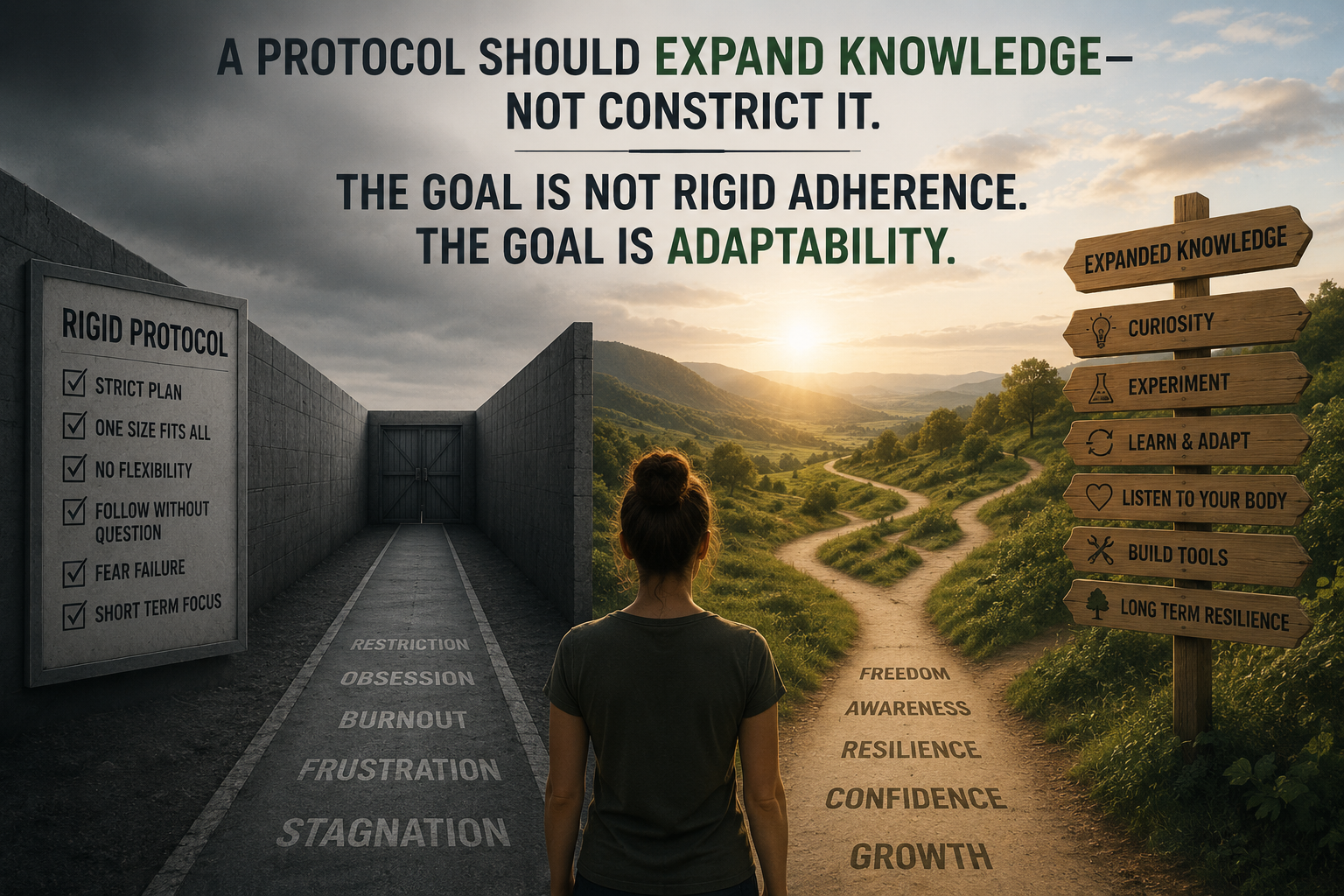
A protocol should expand knowledge—not constrict it.
The goal is not rigid adherence.
The goal is adaptability.
The Difference Between Rules and Understanding
When we approach fitness only through rigid rules, we become fragile.
We think:
“This is the right exercise.”
“That is the wrong exercise.”
“This is the only way to eat.”
“This program is optimal.”
But real health rarely functions in absolutes.
Instead of searching for the “right” exercises forever, we should be expanding our toolbox.
Different tools serve different purposes.
Heavy strength training may build force production and bone density.
Walking may improve recovery and stress regulation.
Mobility work may improve positional awareness.
Conditioning may improve cardiovascular health and work capacity.
None of these are universally superior.
The real skill is learning when to apply the appropriate tool.
That requires awareness.
And awareness requires education.
Embodying Fitness Means Becoming More Adaptable
The deeper purpose of fitness is not perfection.
It is adaptability.
It is gaining more control over inevitable change.
Aging is coming whether we prepare for it or not.
Stress is coming.
Injury is coming.
Unexpected life circumstances are coming.
Fitness, when embodied, is what helps us navigate those realities with greater resilience.
A strong body adapts better.
A conditioned cardiovascular system recovers better.
A person who understands nutrition can pivot more effectively when health changes arise.
A person who has movement options can adjust instead of stopping completely.
In this way, embodying fitness is not just physical.
It is educational.
It is psychological.
It is behavioral.
The Danger of Outsourcing Understanding
Many people spend years outsourcing their health.
They follow programs blindly.
They repeat advice without understanding it.
They search endlessly for the next perfect system.
But eventually life forces adaptation.
The schedule changes.
Pain develops.
Energy drops.
Recovery slows.
And without understanding, people panic.
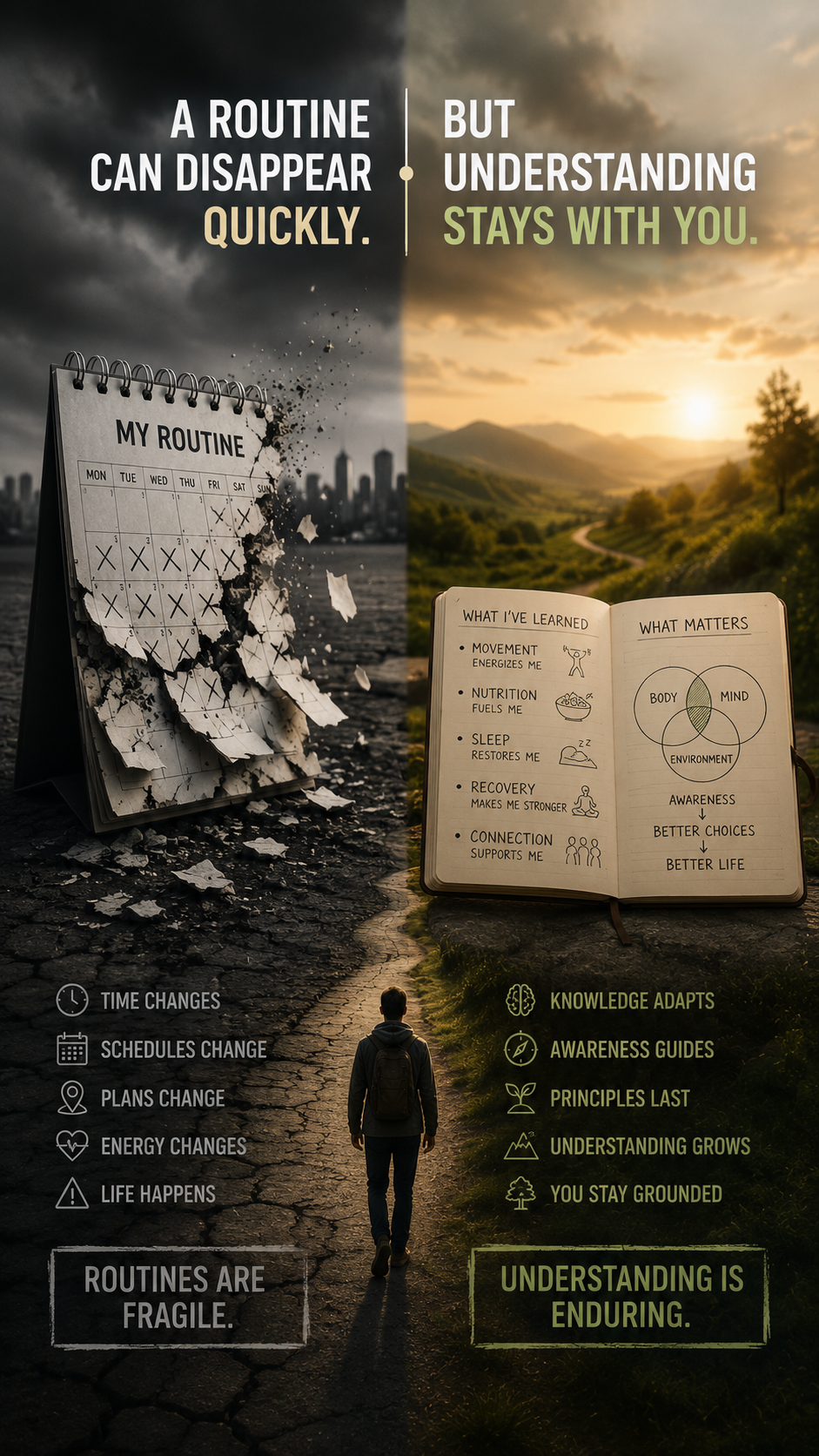
Because the only thing they knew was the routine itself.
This is one reason exercise alone is not enough.
A routine can disappear quickly.
But understanding stays with you.
Investing in Understanding Before You Need It
One of the most important things we can do is invest in understanding our health before we desperately need that understanding.
Because when health truly declines, adaptability becomes harder.
Learning becomes harder.
Energy becomes lower.
Stress becomes higher.
The time to build awareness is before crisis.
That means gathering experience in how we can shift our energy, mood, and resilience through behavioral adjustments. It means building a buffer zone of strength, conditioning, movement competency, and recovery capacity before our physical capabilities are unexpectedly challenged.
If we develop the habit of challenging ourselves and continuing to learn when life is going well, we position ourselves far better to adapt to the inevitable challenges of illness, stress, injury, and aging.
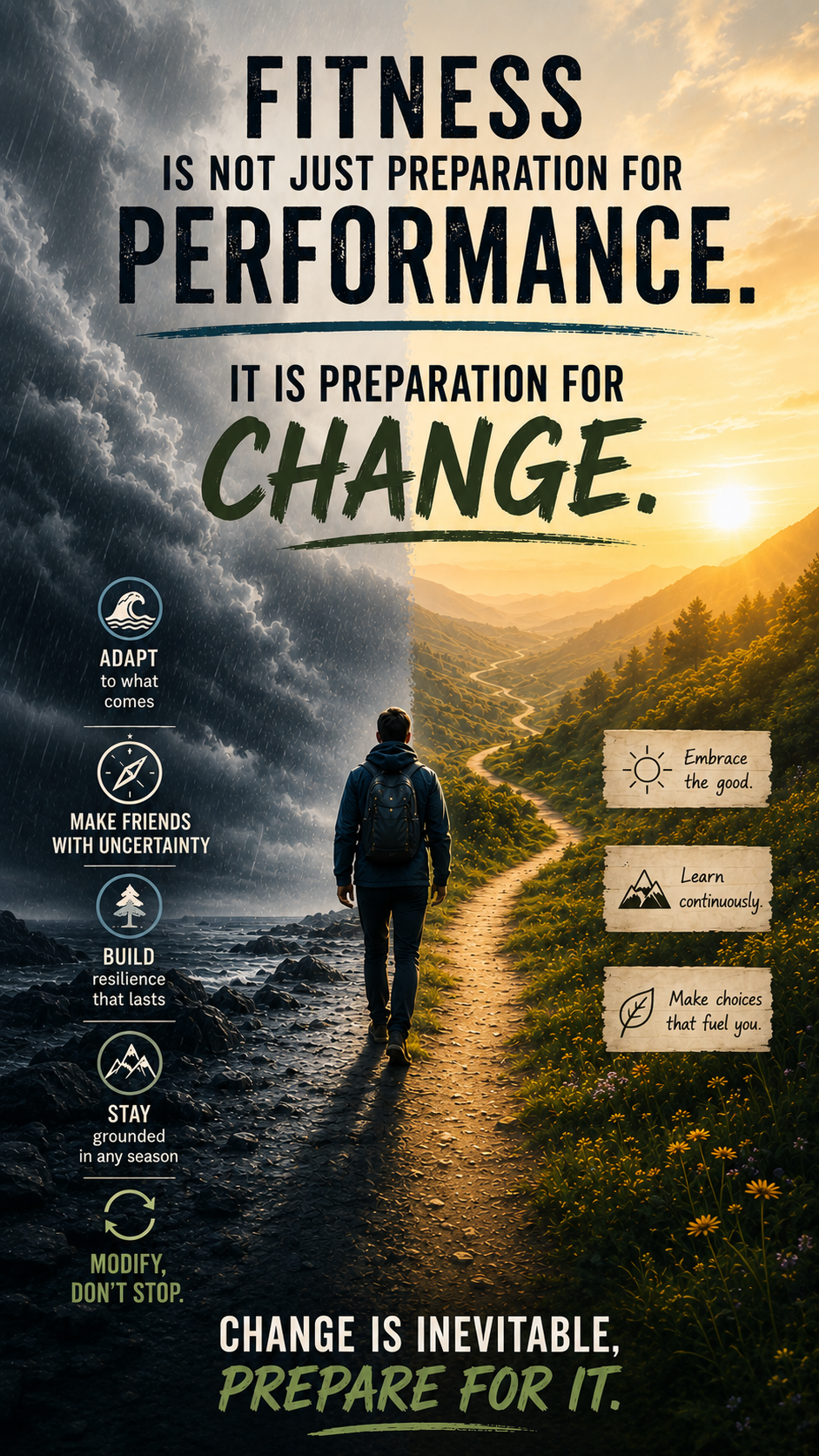
Fitness, in this sense, is not just preparation for performance.
It is preparation for change.
Curiosity Over Certainty
The healthiest people are often the most curious.
Not the most dogmatic.
They remain open to learning.
They evolve.
They adapt.
They don’t abandon previous knowledge every time a new trend appears. They integrate new information into a broader understanding.
That is a much different mindset than constantly searching for the perfect answer.
Because health is dynamic.
And dynamic systems require flexibility.
Embodying Fitness Is Identity-Level
At some point, fitness stops being something you “do.”
It becomes part of how you live.
Not because you found the perfect program.
But because you’ve learned to appreciate the positive cycle that develops when you continually learn about your health and put that knowledge into action.
You begin to experience firsthand how better sleep changes your mood, how movement changes your energy, how nutrition changes your focus, how recovery changes your resilience, and how your environment and habits shape your behaviors.
At that point, fitness stops being something you are forcing yourself to do.
It becomes something you embody.
Not simply because you enjoy it, but because you deeply understand the relationship between your behaviors and your lived experience.
You begin to live those relationships.
What once felt like sacrifice starts to feel obvious.
You no longer feel like you are constantly fighting yourself to make the “right” decisions. Instead, you begin moving with the rhythm of what your body, mind, and environment are consistently teaching you.
That is when health stops feeling like a protocol and starts feeling like part of who you are.
The Real Goal
The real goal of health and fitness is not simply accumulating workouts.
It is expanding your capacity to navigate life.
Physically.
Mentally.
Behaviorally.
Exercise can absolutely be part of that process.
But exercise alone is too narrow a concept.
The deeper objective is becoming someone who understands their body, understands change, and can continue evolving through different stages of life.
Change comes for us all.
When it does, will we be ready?