Imagine arriving at the gym ready to follow your program, only to discover that someone is using the equipment you need. You could wait, rearrange the workout, or decide that the session has already been compromised. But there is another possibility: you understand what that exercise was supposed to accomplish, so you choose another way to accomplish it. The workout changes, but its purpose survives.
That small distinction reveals something much larger about how we approach fitness. If our understanding begins and ends with a list of exercises, we depend on having the right circumstances to perform them. If we understand the categories those exercises belong to, we have options. We can adapt to different equipment, changing interests, and the body we bring into the gym that day without abandoning the direction of our training.
The pursuit of the perfect protocol can make this difficult. In the world of health podcasts and fitness content, including the protocol-oriented conversations many people associate with Andrew Huberman, specificity carries considerable appeal. We want to know exactly which exercise to do, how many repetitions to perform, how long to rest, and which day to do it. There is comfort in having the details settled. A clear prescription can reduce uncertainty and help us begin.
But a protocol can also become a substitute for understanding. We learn the instructions without learning what makes them useful, and then any departure feels like a mistake. Eventually, the question becomes whether we followed the plan correctly rather than whether the plan helped us develop the capacity we wanted. Understanding categories gives us a way to preserve the useful structure while allowing the details to evolve.
The Pattern and the Intention
When I think about an exercise, I find it helpful to ask two questions: What movement pattern am I practicing, and what am I trying to develop through it? The pattern describes the movement family. Squatting, hinging, pushing, pulling, carrying, rotating, and getting up from the ground are examples of categories we might use. These are practical organizing tools, and they overlap. A get-up, for instance, can contain several patterns within one task.
The intention describes the quality we want to emphasize. Strength, power, speed, endurance, and mobility are different intentions, even when they share similar movements. Strength emphasizes the ability to produce force. Power emphasizes producing force quickly. Speed emphasizes how rapidly a movement can occur. Endurance emphasizes sustaining or repeating an effort, while mobility emphasizes the movement options and control available to us.
These qualities are related, but they are not interchangeable. Being able to stand up against a heavy resistance does not tell us everything about how quickly we can stand, how many times we can repeat it, or how comfortably we can move through different depths. A person can be highly capable in one expression of a movement and relatively unfamiliar with another. The exercise name alone does not explain the whole training effect.
Consider the squat. A challenging loaded squat can emphasize strength. A squat performed with an appropriate resistance and the intention to rise quickly can emphasize power. Repeated sit-to-stands can emphasize muscular endurance, while a supported squat can provide an opportunity to explore depth, position, and control. Speed might be explored through a quick, relatively unloaded rise, although that overlaps with power. The family resemblance remains, but the task changes.
This is why changing the intention requires more than changing the label. The resistance, repetitions, rest, range of motion, and manner of execution need to support what we are trying to develop. A power exercise performed until every repetition becomes slow and exhausting has drifted away from its original purpose. Categories create freedom, but understanding the intention gives that freedom direction.
Consistency Does Not Require Sameness
We hear constantly that consistency is the foundation of progress, and for good reason. An occasional burst of effort rarely replaces sustained participation. But consistency is often interpreted as repeating the exact same exercises, in the exact same order, under the exact same conditions. That is one way to organize training; it is not the only way to remain consistent.
We can be consistent about developing leg strength while changing the squat variation. We can regularly practice getting up from the ground while exploring different routes. We can maintain an endurance habit while alternating among walking, cycling, and swimming, recognizing that each also develops its own specific skills. The recurring commitment is to a capacity, with enough repeated practice to make progress meaningful.
This distinction is compatible with current exercise guidance. The American College of Sports Medicine’s 2026 resistance-training update emphasizes regular participation and individualization, while recognizing that training choices should reflect the outcome being pursued. An effective plan does not have to become an elaborate ritual to be worthwhile.
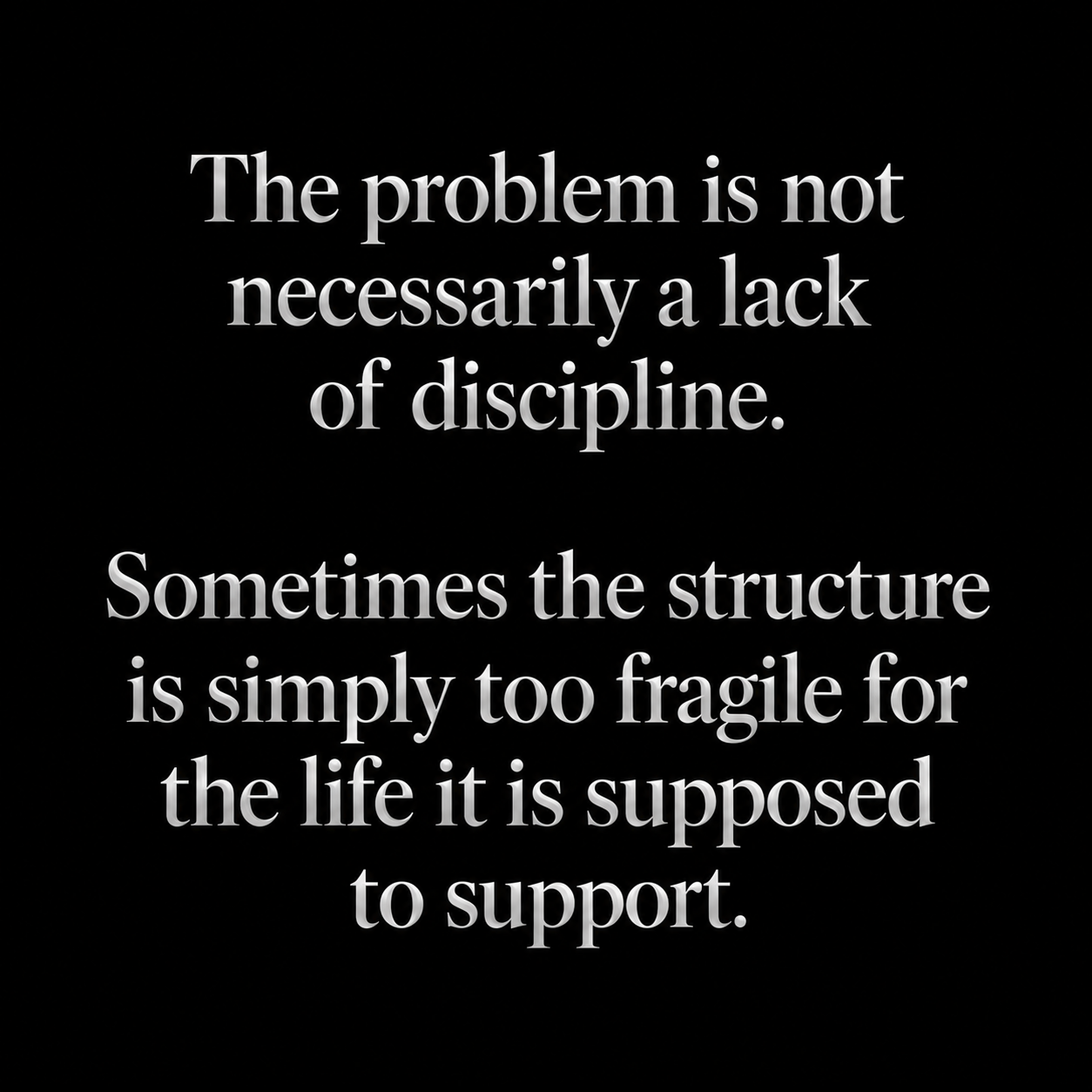
Some people enjoy a highly repetitive program and do very well with it. Repetition can be satisfying, measurable, and especially useful when a specific performance goal matters. But for many people, a plan that cannot accommodate boredom, travel, changing schedules, or shifting interests becomes difficult to sustain. The problem is not necessarily a lack of discipline. Sometimes the structure is simply too fragile for the life it is supposed to support.
There is also a difference between staying with an effective routine and assuming that routine represents everything fitness has to offer. We might become better at a particular exercise while leaving other expressions of the same movement largely unexplored. A broader understanding lets us keep what works and ask what else we would like to become capable of doing.
Variation With a Purpose
Variation is valuable when we understand what it is varying around. If every session introduces an entirely new collection of exercises, it becomes difficult to learn the movements, judge the challenge, or determine whether we are improving. Novelty can produce effort and entertainment without providing a clear direction. Simply working hard does not show us what we are getting better at.
Within a category, however, variation can remain connected to a recognizable goal. A person developing squat strength might spend a period practicing a goblet squat, then explore a different load position or a supported single-leg variation. The details change, but the person is still practicing how to lower and raise the body against resistance. Some capacity may carry over, while the unfamiliar version will still require learning.
That last point matters. Improving one variation does not guarantee equal improvement in every movement within its category. Strength has specific features, and skills require practice. If your goal is a heavier barbell back squat, you will need meaningful exposure to that exercise. But if your goal is a broader ability to lower, rise, and respond to different demands, practicing more than one expression can serve that purpose.
Variation can also redistribute demands and offer alternatives when one version becomes difficult to tolerate. It should not be treated as a guarantee against injury or overuse; the amount of work, the progression, and recovery still matter. Its practical value is that we have more ways to train. We can adjust the challenge instead of repeatedly forcing the same approach or abandoning the category altogether.
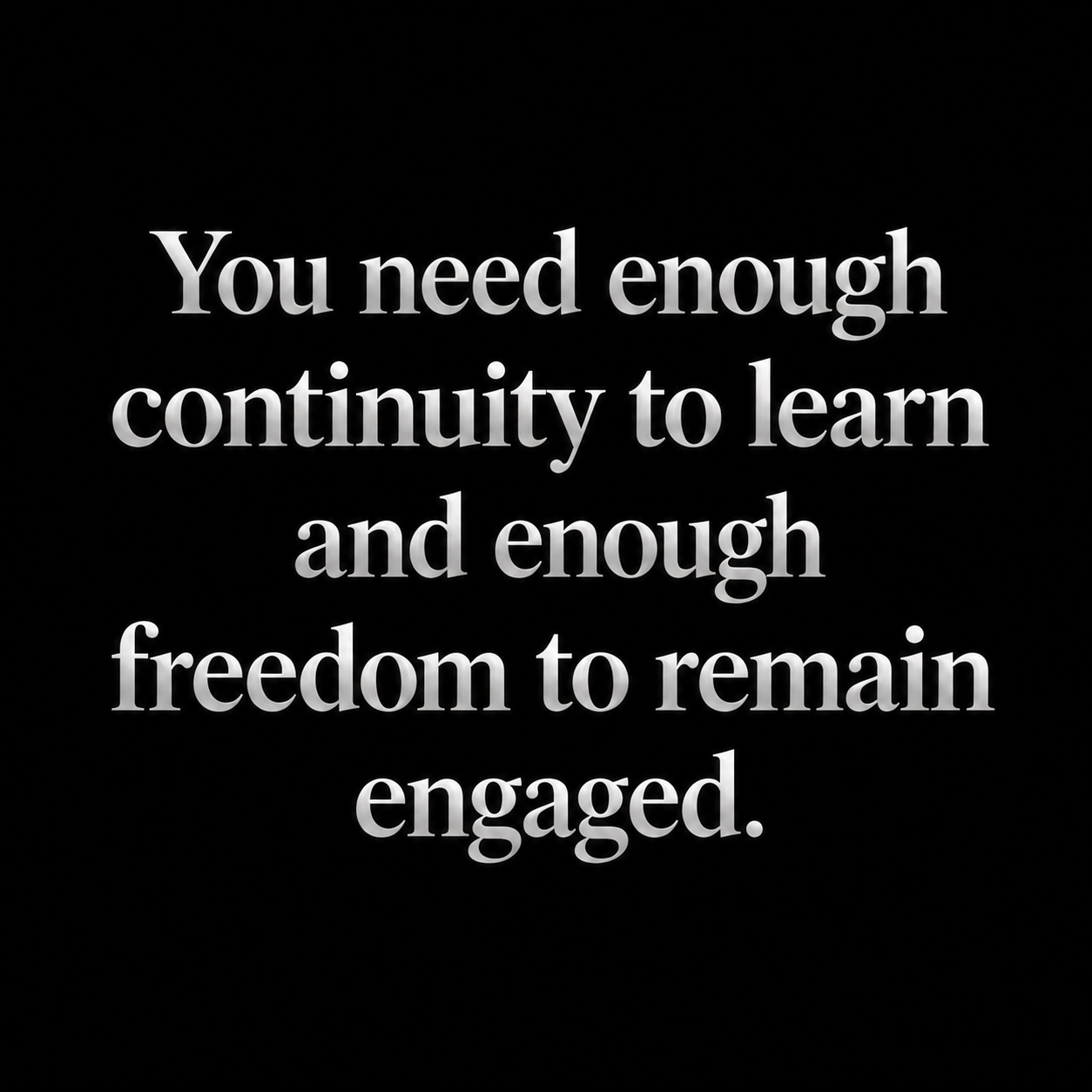
A useful balance is to keep enough stable practice to observe progress while leaving room for exploration. You might retain a familiar strength exercise for several weeks and use another part of the session to explore support, stance, depth, or a different intention. You do not need to change everything whenever you become curious. You need enough continuity to learn and enough freedom to remain engaged.
Moving Beyond Good and Bad Exercises
Categorical thinking also changes how we respond to declarations that an exercise is good or bad. Fitness messaging often treats a movement as though it has one fixed meaning. Squats are good for you, or squats ruin your knees. Deadlifting is essential, or it is dangerous. These statements flatten a wide range of possibilities into a single verdict.
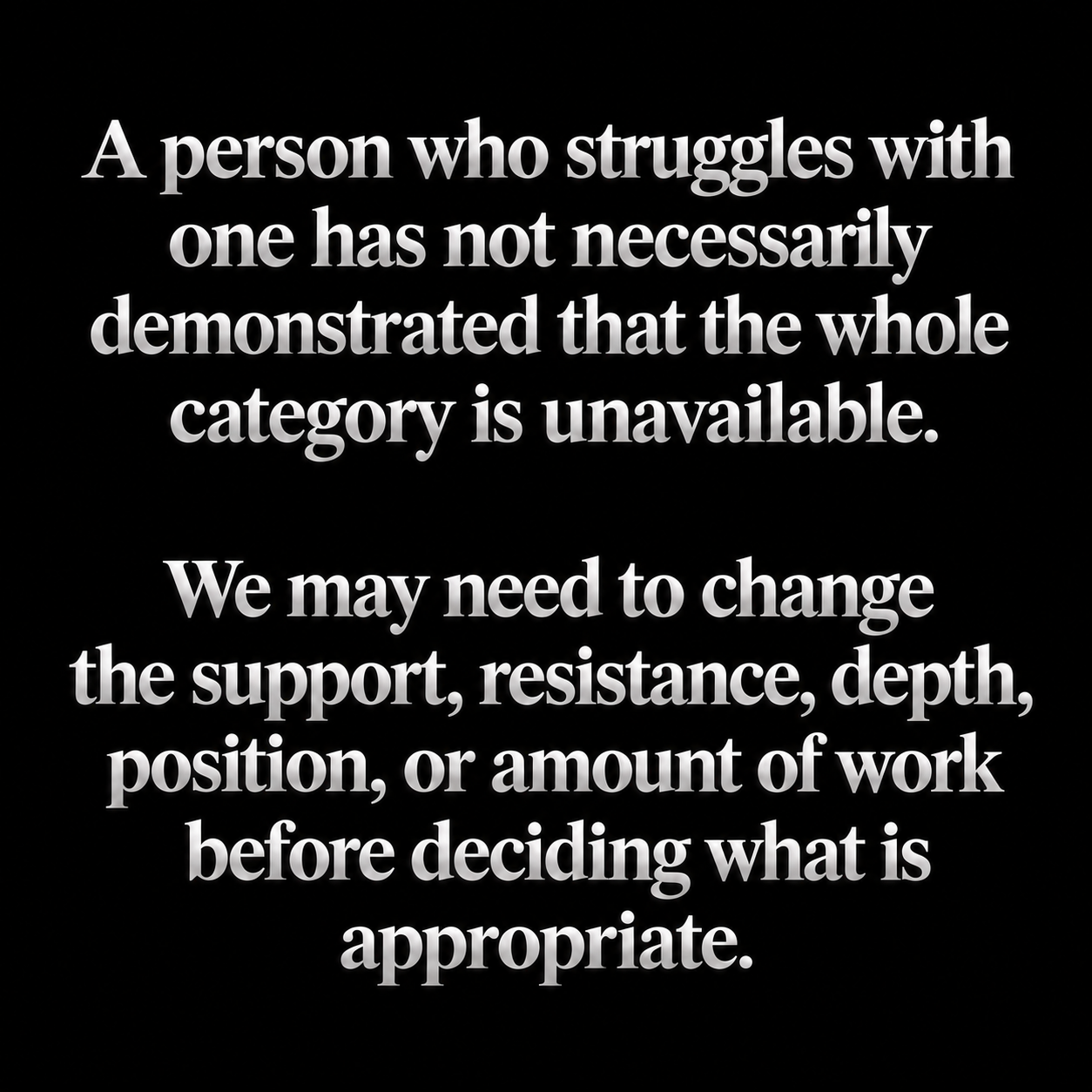
The word “squat” could describe a shallow, supported movement toward a high chair or a heavily loaded descent to substantial depth. Those are related tasks with very different demands. A person who struggles with one has not necessarily demonstrated that the whole category is unavailable. We may need to change the support, resistance, depth, position, or amount of work before deciding what is appropriate.
In physical therapy, this broader view is especially useful. Instead of asking whether someone can perform the version of a movement we have in mind, we can ask where their current entry point might be. For many people, there is an accessible starting point somewhere along the continuum. Sometimes that starting point is small, assisted, or only a component of the eventual task, and some circumstances require further assessment before proceeding.
The category helps us see possibilities that a narrow exercise definition hides. Someone who cannot comfortably perform a free-standing squat might explore a supported sit-to-stand or an unloaded position that allows practice of hip and knee bending. These are not identical tasks, but they can provide related opportunities. The question becomes how to find a useful challenge and develop it from there.
What Stays the Same?
Freedom becomes more useful when we know what must remain stable. These stable features are sometimes called invariants: the things that do not change within the category we have defined. In a squat family, we might preserve the basic action of lowering and raising the center of gravity. We do not need to preserve an identical stance, depth, torso angle, or loading method in every version.
The intention has its own anchors. If we are developing strength, the task needs enough resistance or difficulty to challenge force production. If we are developing power, producing force quickly remains central. If we are exploring mobility, the movement options and control we are practicing remain the focus. We can change the method while retaining the features that make it serve its purpose.
This is where we begin to find our own “secret sauce.” One person enjoys a small set of familiar exercises with occasional adjustments. Another stays interested by rotating among several related options. Neither preference automatically makes the training better. The useful question is whether the approach provides an appropriate challenge, supports the intended capacity, and remains something the person can continue doing.
A Broader Way to Understand Fitness
Thinking in categories has value beyond the gym. When we understand the purpose behind a method, we become less dependent on that method’s exact form. We can recognize what is essential, what is adjustable, and what a change might cost. A recipe teaches us to prepare one meal; understanding ingredients and techniques gives us more ways to feed ourselves when the pantry looks different.
Fitness works similarly. A protocol can be a helpful starting point, but understanding patterns and intentions gives us a way to keep learning. We can pursue strength without neglecting speed, power, endurance, or mobility. We can appreciate a familiar exercise without expecting it to represent every possible demand. We can respond to changing circumstances with choices informed by purpose.
The goal is to become capable enough to adapt. That requires repeated effort, but it also includes curiosity, experimentation, and enjoyment. When we know what we are practicing and why, variation becomes easier to judge and consistency becomes easier to preserve. We can keep returning to the capacities that matter while allowing the way we develop them to grow with us.
Double-click to edit...