We’ve all heard the phrase: “Are we missing the forest for the trees?”
In health care—especially when pain or stubborn symptoms show up—that’s not just a saying. It’s the pattern most of us fall into.
A sudden tweak in your back, a flare in your neck, numbness in your foot, tightness that won’t let go—our instinct is to zoom in and declare:
“Something is wrong with this part. If I can just fix this one thing, I’ll be fine.”
It feels logical. It feels practical.
But usually, it leads us straight into a dead end.
The Problem With Chasing the One Cause
We’re conditioned to approach our bodies like machines: if one part malfunctions, the goal is to find the faulty piece and fix it.
In that mindset, pain becomes a scavenger hunt for the one root cause:
“Which muscle is tight?”
“Which vertebra is out?”
“Which joint is weak?”
“Which nerve is pinched?”
“Which diagnosis explains everything?”
The hope is that there’s a single answer—one tree with the problem-leaf we just haven’t found yet.
But pain, especially chronic or recurring pain, rarely behaves that way.
Trying to find the one “bad leaf,” on the one “bad branch,” on the one “bad tree” becomes an endless, exhausting search that feels productive but rarely leads to meaningful change.
Often, it’s a sophisticated form of procrastination—a way to delay addressing the broader changes that actually matter.
The Specialist Trap: Many Trees, Few Forests
Our healthcare system has become increasingly specialized.
Orthopedists, neurologists, podiatrists, pain specialists, manual therapists, surgeons—each one trained to examine one part of the landscape with incredible depth.
And those are the opinions we’re taught to value most.
But here’s the paradox:
Specialists tend to have the least ability to see the forest.
Their expertise lives at the tree-level: the joint, the nerve, the tissue, the structure.
It’s not their fault—specialization is necessary and often life-saving. But when specialists look at problems that arise from the whole ecosystem of your body… they are often looking through a microscope when what is needed is a wide-angle lens.
When your symptoms come from a forest-level issue—sleep, stress, fitness, strength, breathing, load tolerance, movement variability—a tree-level analysis can miss the bigger story entirely.

Health Isn’t a Tree. It’s a Forest.
When your body sends you a signal—pain, tightness, fatigue, tension—it isn’t handing you a neatly highlighted culprit.
It’s giving you feedback about the entire ecosystem.
Your forest includes:
Sleep
Stress
Movement habits
Strength
Cardiovascular fitness
Breathing patterns
Recovery
Self-awareness
Consistency
Environment
Beliefs about your body
Most of us zoom in on one tree.
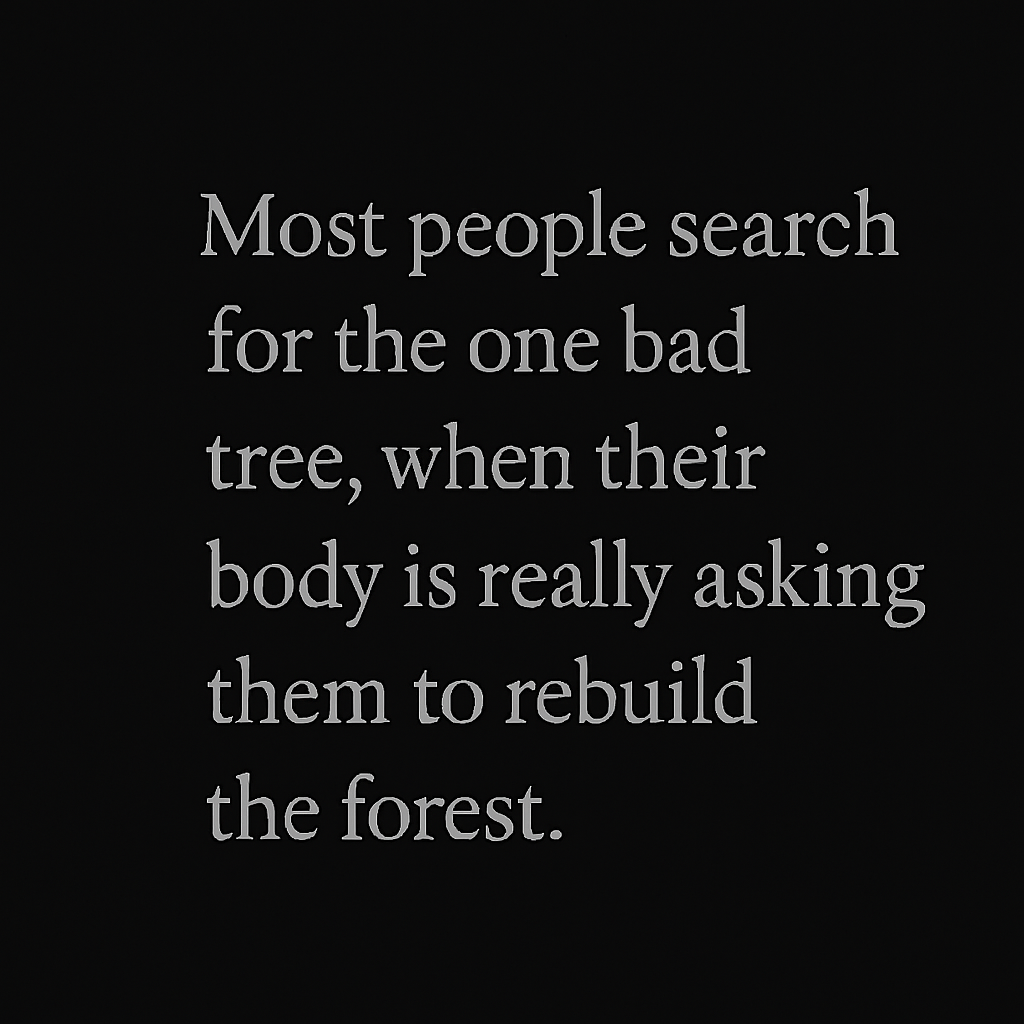
The body, meanwhile, is describing the condition of the forest.
A Stronger Forest Creates Stronger Trees
Here’s the irony:
When you build a healthier forest, the trees tend to take care of themselves.
Improve your sleep → tissue sensitivity drops.
Improve your aerobic fitness → recovery improves dramatically.
Improve your strength → joints feel more supported.
Lower stress → tension decreases and pain thresholds rise.
Add movement variety → you stop overusing the same strategies that irritate the same structures.
These “big rocks” aren’t glamorous. They don’t give you a tidy diagnosis. They don’t promise a quick fix.
But they create a foundation strong enough that the little problems resolve without being micromanaged.
Robust forest → healthier trees.

The Trap of Tree-Hunting
When we rely on microscopic specificity—specific stretch, specfici muscle, specific diagnosis—it often creates false hope:
“Once I fix this one thing… everything will get better.”
But for chronic or long-standing issues, the opposite is usually true:
You need broader, not narrower, solutions.
A bigger aerobic engine.
More resilient tissue.
More adaptable movement strategies.
More distributed strength.
More capacity across the whole system.
Tree-hunting narrows your world.
Forest-building expands it.

Zooming In Still Matters—But Not First
As clinicians, coaches, and movement professionals, we do sell trees.
We help people refine mechanics, improve joint control, and build specific skills.
But those details only matter inside a thriving ecosystem.
If someone’s forest is depleted—poor sleep, limited movement, chronic stress, low strength—hunting down the “bad tree” is like pruning a leaf during a drought.
It’s effort spent in the wrong place.
First, nourish the forest.
Then, refine the trees.
So Which Should We Focus On? Forest or Trees?
The real question isn’t:
"Which tree is causing my pain?”
The real question is:
“Is my forest healthy enough to support the stresses of life?”
Most of the time, the body isn’t pointing to one culprit—it’s pointing to the larger ecosystem that needs attention.
Better sleep
Better strength
Better fitness
Better stress regulation
Better movement
Better habits
Better recovery
Better self-trust
These broad, foundational changes carry most of the healing weight.
Once the forest is robust, the trees—the individual joints, muscles, and movement patterns—finally have the environment they need to thrive.
Double-click to edit...